comment 0

Help for Educators Falsely Accused of Antisemitism

3 of 3. If you are falsely accused of antisemitism, remember that you are not alone—nor should you be. Your union rep should accompany you to all meetings. Document everything. Send emails after each meeting summarizing what was said. Keep a record. Reach out to your local Palestinian rights community; chances are they can connect you to others who have faced what you have—and connect you to lawyers if need be. Contact Palestine Legal https://palestinelegal.org/intake for free legal help, and use The Institute for the Understanding of Anti-Palestinian Racism https://antipalestinianracism.org/  as a resource. We are a large, supportive community who agrees with you that it is not wrong to teach about human rights! Questions, need suggestions for lessons? please email me at palestineteachingtrunk@gmail.com.

comment 0

Responding to False Accusations of Antisemitism

2 of 3.  How can educators who teach about Palestine answer false allegations of antisemitism? Last weekend, two colleagues and I attended the NW Teaching for Social Justice conference and gave a workshop on this topic. We suggested using a toolkit developed by Nora Lester Murad and Alice Rothchild called https://idainthemiddle.com/teaching-resources/toolkit-to-defend-k-12-educators-librarians-against-false-accusations-of-antisemitism/.  Briefly, teachers and librarians should establish their antiracist classrooms and libraries from the beginning of the school year. Bring in diverse voices and issues from around the globe and throughout history. Palestine has its own beautiful culture and language, and is one of many places suffering from racism, segregation, apartheid, ethnic cleansing, settler-colonialism, and imperialism. If you have already been teaching about peoples and issues around the world, then Palestine fits right in. Let your principal and parents (and union rep) know that this is how you’re teaching from the start of the year. When Palestine is seen as another fascinating culture — but also part of a larger pattern of global injustice–, your classroom and library are much more protected from claims that teaching about Palestine is antisemitic. Questions, need suggestions for lessons? please email me at palestineteachingtrunk@gmail.com.

comment 0
What is Anti-Palestinian Racism?

1 of 3. Accusing educators who teach about Palestine of being antisemitic is part of a pattern, especially in the US, of anti-Palestinian racism. According to The Institute for the Understanding of Anti-Palestinian Racism https://antipalestinianracism.org/, anti-Palestinian racism includes:

  • Denying the Nakba;
  • Justifying violence against Palestinians;
  • Failing to acknowledge Palestinians as an Indigenous people with a collective identity, belonging and rights in relation to occupied and historic Palestine;
  • Erasing the human rights and equal dignity and worth of Palestinians;
  • Excluding or pressuring others to exclude Palestinian perspectives, Palestinians and their [non-Palestinian] allies;
  • Defaming Palestinians and their [non-Palestinian] allies with slander such as being inherently anti-semitic, a terrorist threat/sympathizer or opposed to democratic values. 
comment 0

Highlights of the Trunk – a 2-week unit

We’ve just collected some of the most thought-provoking and active lessons from the Trunk and compiled them into a 2-week unit of study. Check out the 55-page lesson on the website menu called “Highlights”. We’ve included an updated Occupation Game, soldiers writings, a role play based on the movie Promises, a Wall activity, a reading with Black Lives Matter activists discussing similarities with Palestinians living under occupation, and maps. Appropriate for any high school class and level. We hope you’ll check out the new unit!

comment 1

What if the conflict came to our own community? Maps, Poems, Stories

Gaza is very small. It’s only 40 km x 10 km. Have your students draw a map of their own community and see where Gaza would fit. Below is an example using Seattle (map designed by Dennis Blum).
Ask students to research what happened in the Gaza conflict (or show the vimeo One Family in Gaza).  Write a poem or story about what would happen if that occurred in each student’s own community.  Ask students to be very specific.  For example, “I-5 would close and Dad couldn’t go to work” or “Swedish Hospital would lose power”.

Gaza_over_Seattle_w_Title

comment 1

Promises Role Play Leads to Engaged Critical Thinking

Teachers, you may already have been using the Promises DVD in your classroom. Here’s a way to extend the learning much further. First, show Promises (which introduces your class to both Palestinian and Israeli children). Next, show the update on the children, available as a special feature on the DVD.  Finally, use the Role Play in the curriculum. The Role Play asks each student to take on the role of one of the Promises children. Then students try to negotiate a just peace agreement.

A teacher who just tried this with his students was thrilled at the levels of engagement and discussion and deep critical thinking.

FilmsMedium

comment 0

A Lesson for Visual Learners, ELLs & Middle Schoolers

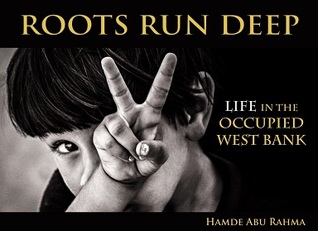
Roots Run Deep by Hamde Abu Rahma (available online or on loan in the Trunk) is a book I just discovered. Hamde, an accountant from the Palestinian village of Bil’in, became a photojournalist to document the impact of occupation after his brother was critically injured and his cousin was killed. Every page in this book has one intriguing photo and a paragraph of text. It is very accessible for all students, including visual learners, English Language Learners, and Middle Schoolers.

Here’s one way you could use this book in a lesson exploring Palestine. First, use the Movement Grid lesson in the Trunk (in the Dig Deep unit p. 6-9) so students discover what it is like to have their own community divided by a Wall. Then, use Roots Run Deep to explore what is happening in Palestine (with the Wall, settlements, land confiscation, house demolition, etc.). Show a picture from the book. Ask students what they notice, what they think might be going on, why they think it might be happening, what they wonder. Then read the paragraph of text to the students. Discuss. Afterwards, ask students to search for another vivid image on the web that shows a different aspect of the Israeli-Palestinian conflict. They can share with their classmates and/or write their own paragraphs about what is happening.

18270238

comment 0

Movies, Games & Study Guides

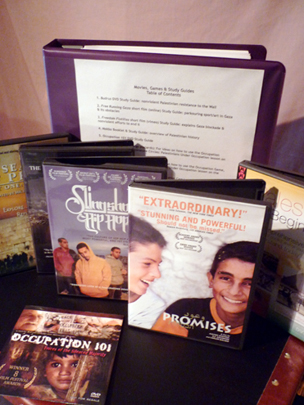
The Trunk offers study guides to two movies that show the Palestinian narrative (The Land Speaks Arabic) and the Israeli narrative (In Search of Peace) of when Israel was founded and most Palestinians were forced from their land. You will find study guides to many of the best movies about the Israeli-Palestinian conflict: Promises, Slingshot Hip Hop, Occupation 101, Palestine for Beginners…. If you are in Western Washington state and can borrow the physical trunk, we furnish you with copies of the movies too. Also included is the Occupation Game, with 100 playing cards. Students write a prose poem in response to various occupation situations.

FilmsMediumIMG_0046

comment 0

Literature Circles for Middle & High School

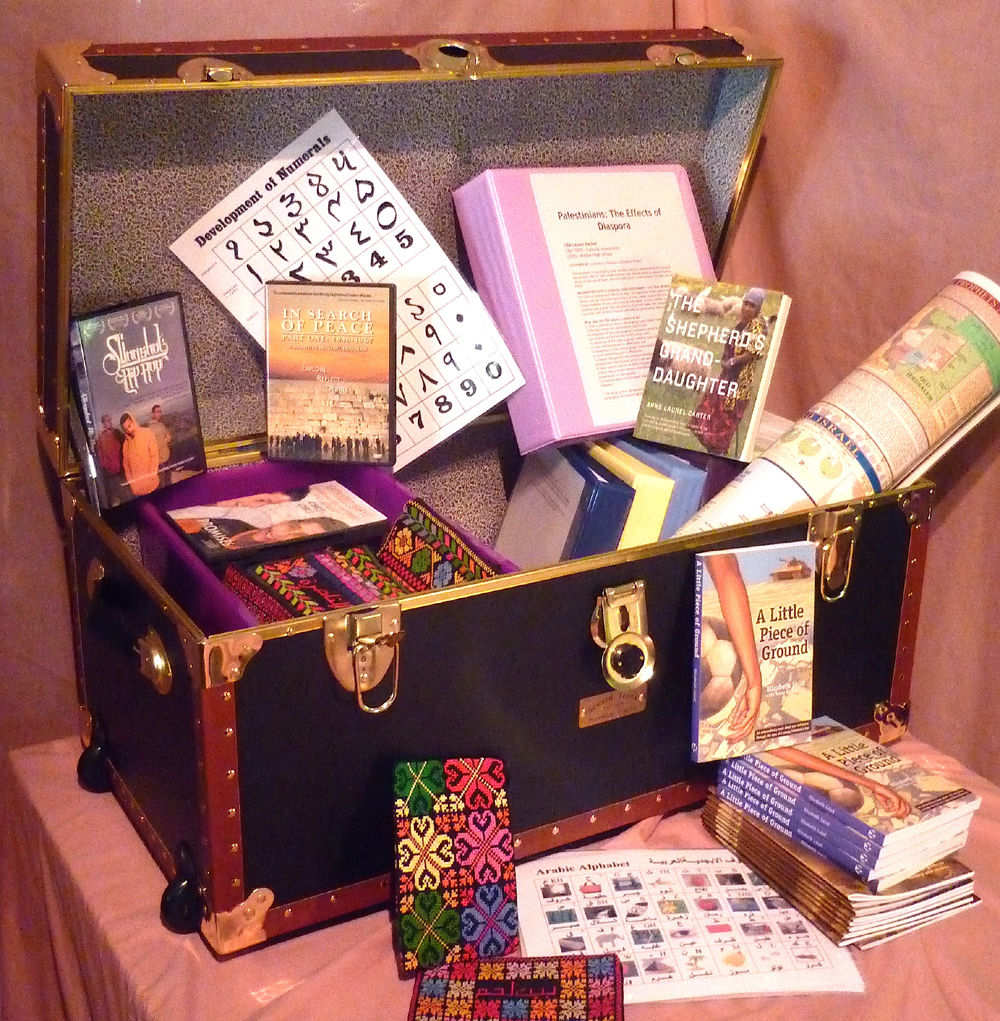
This curriculum can be taught in middle or high school. Students form Literature Circles to read young adult novels set in the Occupied Territories. The two novels are The Shepherd’s Granddaughter and A Little Piece of Ground. Enlarge the picture below to spot the two books. One novel has a male protagonist and is set in the 1990s in a city. The other novel has a female protagonist and takes place in the countryside during the early 2000s. If you borrow the physical trunk, we have 34 copies of each novel for you, along with discussion questions and suggestions for extending the activities.

Trunk

comment 0

Teaching 12th graders

This unit about cultural interactions is recommended for twelfth grade. In it, students learn about Palestinian culture pre-1948. Then they compare it with Palestinian culture in the Occupied Territories or in the diaspora in the present day.

IMG_0042